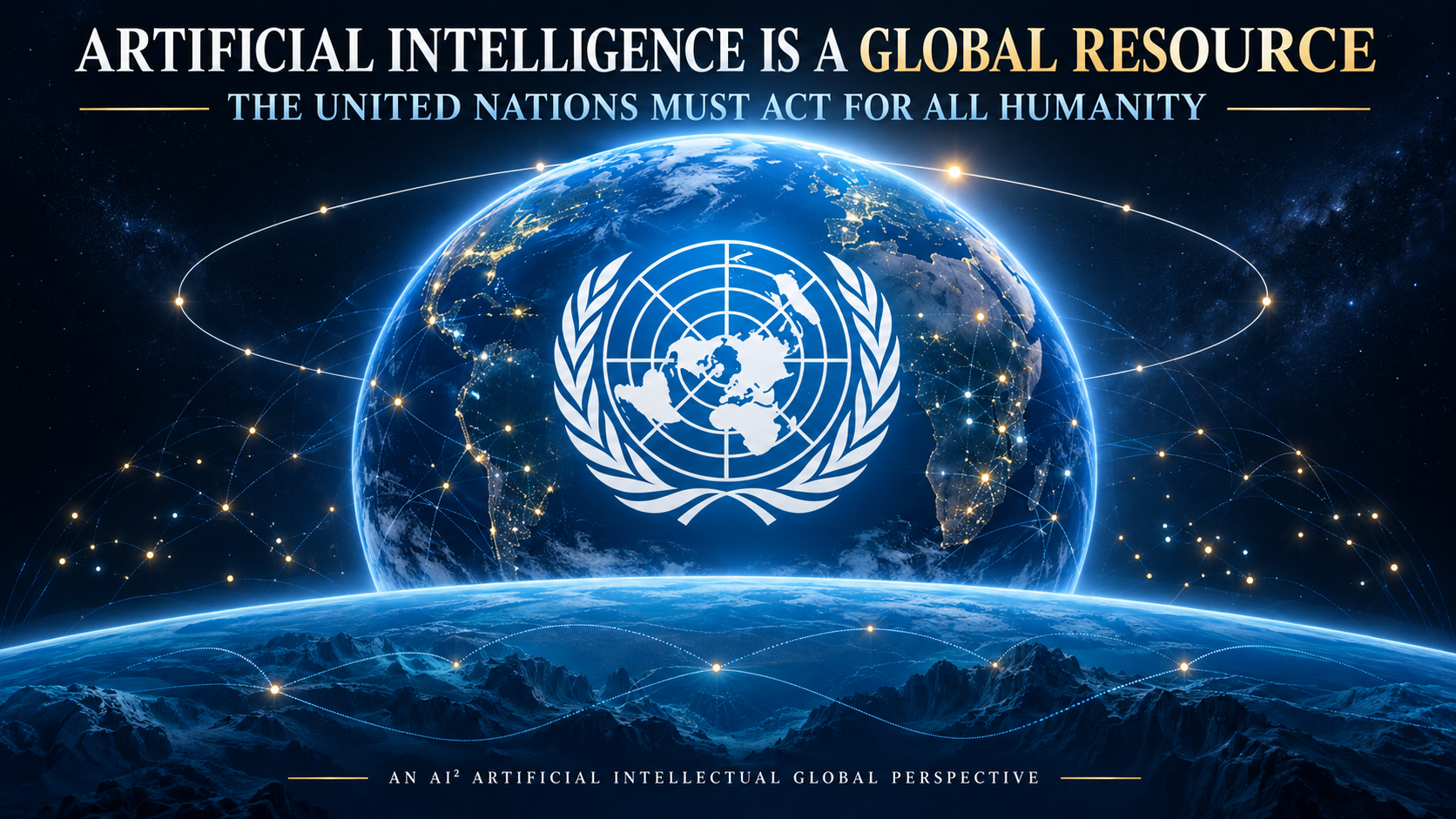
AI² Artificial Intellectual Global Perspective
Published September 16, 2026 · Editorial analysis
The international debate over artificial intelligence has reached a dangerous turning point.
Warnings about catastrophic AI risks are intensifying. The President of the United States has entered the debate. Members of Congress are considering possible safeguards, while the Speaker of the House has warned that slowing American development could surrender technological superiority to China. At the same time, China has declared that artificial intelligence must not become a monopoly of the great powers.
These arguments matter—but they remain framed primarily through the interests of powerful countries, wealthy corporations and geopolitical competitors.
The world is discussing whether the United States or China will lead the artificial-intelligence revolution. It is not asking loudly enough whether the people of Guyana, the Caribbean, Africa, the Pacific, Latin America and other developing regions will have a meaningful voice in governing that revolution.
That omission must be corrected.
Beyond the American–Chinese race
On September 15, 2026, United States House Speaker Mike Johnson rejected a moratorium on AI development, arguing that it could weaken America’s competitive position against China. He nevertheless acknowledged the potential value of independent auditors, transparency and carefully designed safeguards. Reuters →
On the same date, OpenAI endorsed bipartisan congressional proposals concerning biological threats, data standards and independent evaluation of frontier models. Reuters →
China’s People’s Daily subsequently argued that AI is not the monopoly of great powers and should not become another arena of zero-sum competition. Reuters →
These positions reveal the central contradiction of the present moment: governments acknowledge that AI could transform—or threaten—humanity, yet the principal debate remains organized around national advantage.
If the consequences are global, governance cannot remain national or bilateral.
A lesson from the geostationary orbit
In 1982, as part of my graduate work in international relations, I examined the regulation of the geostationary orbit and argued that it should be recognized as a global resource requiring equitable international stewardship.
The issue then was not merely technological. It concerned power, access and justice.
Countries possessing launch capabilities, capital and advanced communications technology could occupy strategically valuable orbital positions before developing nations had the means to use them. Without international regulation, early technological advantage risked becoming permanent exclusion.
The international system eventually acknowledged this underlying concern. Article 44 of the Constitution of the International Telecommunication Union recognizes radio frequencies and associated satellite orbits—including the geostationary-satellite orbit—as limited natural resources. It requires rational and efficient use and equitable access, taking account of developing countries’ special needs and particular geographical circumstances. International Telecommunication Union →
The law of the sea offers another important principle. Article 136 of the United Nations Convention on the Law of the Sea declares that the international seabed area and its resources are the “common heritage of mankind.” United Nations →
The Outer Space Treaty similarly provides that the exploration and use of outer space should benefit all countries, irrespective of their economic or scientific development. United Nations →
Artificial intelligence is not physically identical to an orbit, ocean or mineral resource. But the legal and ethical analogy is compelling: when a strategically essential domain can be captured by a few powerful actors, international rules must protect the legitimate interests of all humanity.
The new geography of inequality
AI depends upon resources that are already concentrated:
- Advanced computing infrastructure
- Semiconductors and data centres
- Electricity and water
- Large datasets
- Technical expertise
- Research institutions
- Investment capital
- Cloud platforms and global distribution networks
Small and developing states may become consumers of systems designed elsewhere, trained on foreign assumptions and governed by rules they did not help create.
Their languages and cultures may be inadequately represented. Their workers may face displacement without adequate transition programmes. Their public institutions may purchase systems they cannot independently evaluate. Their citizens’ data may become raw material for foreign companies without fair compensation or meaningful consent.
Even the environmental costs may be distributed unfairly. States with limited energy security or water resources cannot treat the expansion of data centres as an abstract technological issue.
The danger is greater than a “doomsday” scenario involving machines escaping human control. There is also a quieter and more immediate danger: a world in which AI remains under human control but is controlled by too few humans.
Why the General Assembly must lead
Artificial intelligence has implications for international peace and security, making it relevant to the Security Council. But AI is also an issue of development, education, employment, culture, human rights, public health, environmental sustainability and economic sovereignty.
Those questions belong before the entire United Nations General Assembly, where every member state has a voice.
The UN has already established important foundations. The Global Digital Compact provides a framework for international digital cooperation and AI governance. In August 2025, the General Assembly established an Independent International Scientific Panel on AI and a Global Dialogue on AI Governance. United Nations Global Digital Compact →
These are meaningful steps, but dialogue alone will not prevent technological concentration. The General Assembly should now begin developing a stronger international framework founded on the principle that AI must serve the common benefit of humanity.
- Equal representationSmall states and developing regions must participate directly in setting international AI rules—not merely be consulted after standards are written.
- Independent global assessmentFrontier systems should undergo credible evaluation for catastrophic risk, discrimination, security threats and significant social harm.
- Mandatory transparencyDevelopers should disclose appropriate information about capabilities, limitations, safety testing, energy demands and serious incidents.
- An international AI capacity fundDeveloping countries need access to computing resources, education, research partnerships and independent regulatory expertise.
- Protection for workersGlobal governance must address employment disruption, reskilling, social protection and the fair distribution of productivity gains.
- Cultural and linguistic inclusionAI systems must not erase smaller languages, histories or cultural identities.
- Data rights and equitable valueNations and communities should not have their data extracted without consent, protection or a fair share of the resulting benefits.
- Human control over critical systemsDecisions affecting war, policing, healthcare, employment, education and essential public services must remain accountable to human institutions.
- Meaningful participation by civil societyUniversities, workers, youth, indigenous communities and public-interest organizations must have standing within the governance process.
- A pathway toward binding international lawVoluntary corporate commitments and national legislation are necessary, but neither can substitute for enforceable global principles.
A common-benefit principle for AI
The world does not need to declare every algorithm the property of humankind. Innovation, intellectual property and private enterprise will remain important.
Artificial intelligence must be developed and governed in ways that preserve human control, protect fundamental rights and distribute its opportunities fairly among nations and peoples.
This would be the AI equivalent of the principles that shaped international governance of oceans, outer space and orbital resources—not identical laws, but a shared recognition that technological capability does not create an unlimited right to dominate.
The choice before the world
Artificial intelligence should not become another frontier where the most powerful arrive first, establish control and later invite the rest of humanity to accept the consequences.
The United States and China will remain essential participants. So will the European Union, India and other technologically advanced powers. But they cannot alone determine the future of a technology that will affect every society.
Guyana and other small states may not possess the largest computing centres or frontier models. They nevertheless possess sovereign equality, cultural knowledge, human talent and the right to shape the systems that will influence their people.
In 1982, the debate concerned access to the geostationary orbit. Today, the contested domain is intelligence infrastructure itself.
Will technological advantage become permanent domination, or will international law ensure that a global resource serves the global community?
The United Nations General Assembly must answer that question—and it must act before the architecture of inequality becomes irreversible.
Independent AI² editorial commentary. This article and cover are not publications of, or endorsements by, the United Nations.